Verifying AI-Generated Code Is a Different Job Than Reviewing It
The hard part is no longer spotting ugly code. It is proving a clean change did not alter behavior the model never understood.
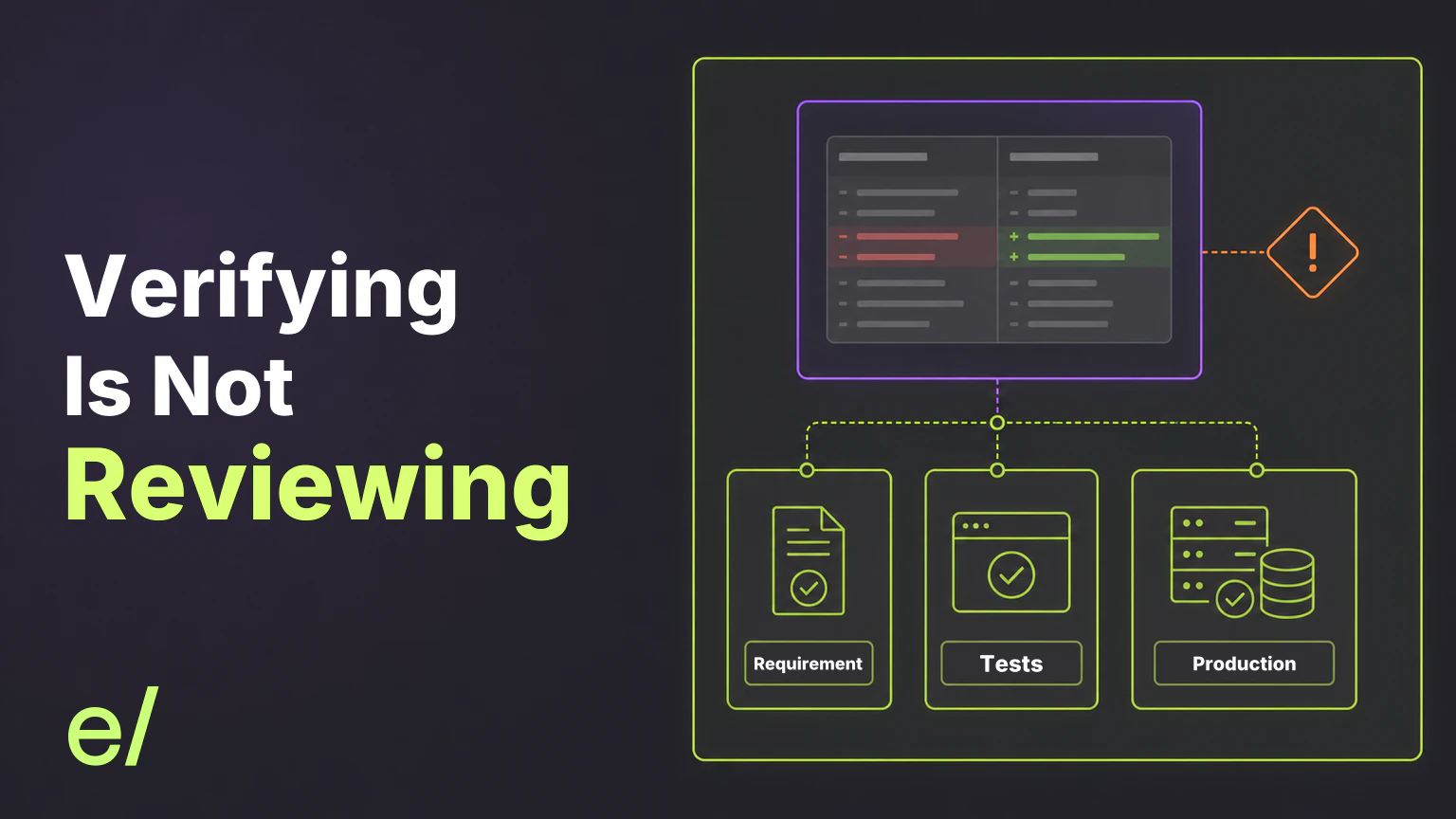
Verifying AI-generated code means checking whether a change meets its requirements and preserves the behavior that should remain intact. Reviewing it means evaluating whether the implementation is sound. Review contributes evidence, but it does not complete the verification job.
Code review starts from the proposed change and can reach beyond the diff into callers, tests, and repository context. That context helps identify risk. It does not automatically establish how the release candidate behaves under the conditions that matter.
That gap is not new. What is new is how much change can now move through it without adding review capacity or product context.
So the release question shifts. It is no longer only “is this code good?” Increasingly it is “what existing behavior did this change put at risk?”
Teams can generate more code, open more pull requests, and move faster through implementation. The product does not become easier to understand just because the change was faster to write.
For a current comparison of the agents and development environments producing those changes, see 9 Best AI Coding Tools for Developers in 2026.
What Is AI-Generated Code Verification?
To verify AI-generated code, a team needs to compare the change against the outcome it is supposed to preserve or produce.
That includes the task requirements, the code diff, the test results, and the existing product behavior that customers already rely on. Each one answers a different question:
- Requirements answer whether the change matches the work that was requested.
- Code review answers whether the new code appears locally correct.
- Tests answer whether known assertions still pass.
- Product behavior answers whether the system still works the way users expect.
The last point is the one many teams miss. A pull request can satisfy the task, pass tests, and look clean in review while still changing a downstream behavior no reviewer had loaded into their head.
This is why verifying AI-generated code is not just a stricter version of code review. It is a broader check against the system.
For more context on that distinction, see Reviewing the Diff Was Never the Hard Part.
Why Code Review Is Not Enough
Reviewing AI-generated code is still useful. It can catch local defects, unsafe patterns, missing checks, and inconsistent implementation choices. AI code review tools can help with that work, and many teams should use them.
But review is limited by its frame. It starts with the change. Verification has to start with the product behavior that might be affected by the change.
Three things keep that gap open.
Repository context is not behavioral proof
Modern code review can inspect more than changed lines. GitHub documents repository-aware Copilot review, while also requiring users to validate its feedback. Reading a caller or a test can reveal a risk without establishing whether that behavior still works.
Review and verification therefore overlap, but their outputs differ. A plausible explanation is not an executed check. A passing check is not evidence for behavior it never exercised. The release owner needs both the reasoning and its validation limits.
Intent does not describe the impact
One of the most useful code review questions is “why did you do it this way?”
That question does more than challenge style. It surfaces the assumption behind the implementation. A reviewer can discover that an engineer optimized for a billing edge case, worked around a migration, preserved an enterprise permission rule, or misunderstood the task entirely.
The prompt can explain the requested change, and the person directing the work can explain the goal. Neither establishes every existing behavior that depends on the code. The reviewer still has to reconstruct the impact.
AI increases change volume faster than review capacity
Review capacity is still a human number. It is bounded by how many diffs a person can understand, how much context they can keep in their head, and how many assumptions they can challenge in an afternoon.
AI generation capacity is not bounded the same way. A team can produce more code without producing more reviewers, more product context, or more time to reason about side effects.
The bottleneck moves from writing code to verifying impact. If the verification process does not change, faster implementation can create slower release confidence.
How to Verify Before Shipping
The practical goal is not to make every change slow. The goal is to separate local code review from system verification so teams know which question they are answering.
Use this checklist before shipping AI-generated code:
-
Confirm the task boundary. Make sure the generated code solves the actual requirement, not just a plausible version of it. Check adjacent behavior that shares the same state, validation, or permissions logic.
-
Review the diff for local correctness. Check security, data handling, error states, naming, API usage, and maintainability.
-
Check the relevant tests. Confirm that existing tests still pass and add targeted tests for the behavior the change is meant to affect. Derive expected results independently of the implementation, using the method below.
-
Identify affected behaviors. Ask which customer-facing or operational behaviors depend on the code that changed, including behavior outside the pull request’s immediate task.
-
Compare against existing behavior. Look for behavior that changed unintentionally, especially outside the files the pull request changed.
-
Decide whether the risk is acceptable before release. A known behavior change can be a product decision. An unknown behavior change is a release risk. The team should make that decision before customers encounter the result.
Security and dependency checks remain necessary alongside these behavioral checks. NIST SSDF v1.1 recommends designing and running security tests and documenting their results. A clean security report does not establish that dependent product behavior stayed intact.
For a broader comparison of review tools, see Best AI Code Review Tools in 2026.
Check the tests, not just their result
Validate AI-generated tests against expectations established outside the generated implementation. A second model or a fresh session can provide another perspective, but neither alone makes the evidence independent.
- Establish the expected result first. Use acceptance criteria, API contracts, and domain-owner-reviewed examples. Resolve ambiguous requirements before treating either the code or its tests as correct.
- Inspect the assertions. Check that they enforce those expectations rather than copy a value or calculation from the implementation. Review mocks for assumptions that exclude the failure being investigated.
- Challenge the check. In an isolated test environment, introduce a known fault or use a failing input and confirm the relevant assertion detects it. This tests that assertion, not the completeness of the suite.
- Exercise boundaries and preserved behavior. Include rejected inputs, permission failures, retries, and important existing contracts where relevant. Run dependent-component checks when a unit test cannot cover the interaction.
- Record the limits. Attach results to the candidate revision. Name scenarios not exercised and the person responsible for resolving or accepting the gap.
Consider a hypothetical invitation-expiry change, not a customer incident. The approved rule says a token is invalid at or after 72 hours. An implementation accepts it at exactly 72 hours, and a generated test copies that expectation. Both artifacts agree, but the requirement is violated.
| Independent expectation | Check to run |
|---|---|
| A valid token still works immediately before expiry | Fix the clock just before the boundary and verify acceptance. |
| The token is invalid at and after expiry | Test both points and assert that no membership is created. |
| Accepted memberships remain valid | Verify that expiry logic does not revoke an existing membership. |
| The dependent client handles rejection | Exercise the expired-token response through the client, not only the endpoint. |
The example illustrates how to test an assumption. It does not establish that all related behavior is covered. Use the release-evidence checklist to carry those limits into the shipping decision.
What to Check
Verification needs a reference point. Without one, the team is only asking whether the change seems reasonable.
The common reference points are useful, but each has a boundary.
| Reference point | What it covers | What it misses |
|---|---|---|
| Tests | Behavior someone expected and wrote down | Unknown dependencies, untested flows, and behavior nobody thought to assert |
| Snapshots and contract tests | Recorded behavior for selected interfaces or outputs | Surfaces nobody chose to record, plus behavior that changed outside the contract |
| Monitoring | Real production behavior after release | Pre-release prevention. It usually reports after customers have already hit the problem |
| Production behavior | The product customers already rely on | It does not explain intent by itself. It gives the baseline to compare against |
Tests are a reference point for behavior someone wrote down. They are valuable, but they cannot cover behavior nobody knew to assert.
Snapshots and contract tests compare against recorded behavior. They are closer to verification, but they only cover the surfaces someone chose to record and maintain.
Monitoring is a reference point for real production behavior. It is highly valuable, but it usually reports after customers have already encountered the problem.
Production behavior is a valuable reference for what users currently experience, but it is not automatically the desired behavior. Existing defects and intentional changes still need to be distinguished.
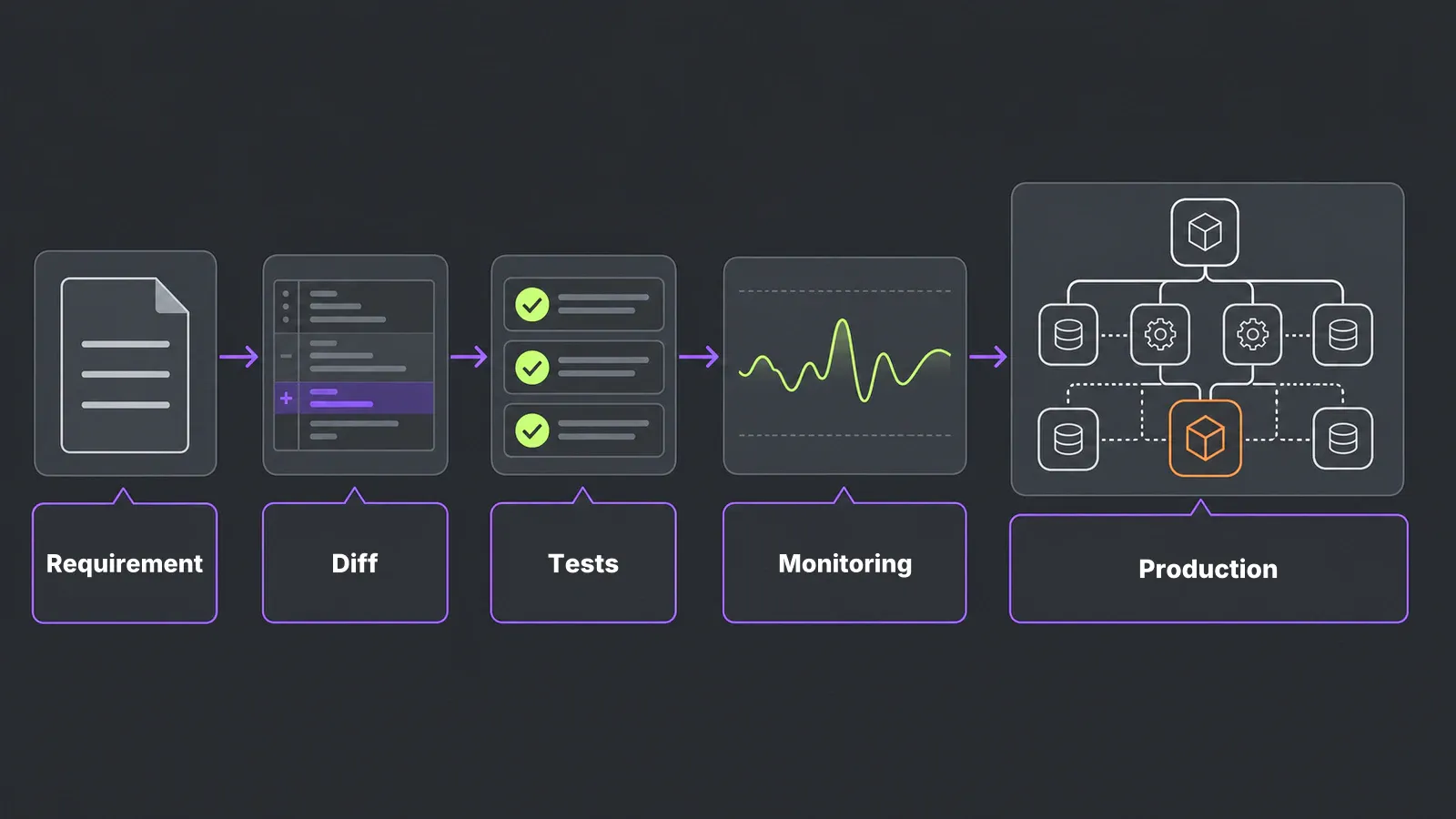
Choose an approved baseline and state what it represents. Combine that reference with requirements and observed results rather than treating any one source as a complete specification.
Where Regression Analysis Fits
Regression analysis is not a replacement for code review. It answers a different question.
Code review asks whether the implementation is sound against the task and available context. Regression analysis asks which established behaviors the candidate may have changed, including effects outside the edited files.
Analysis can direct verification toward affected behavior. Runtime checks are still needed for claims that depend on execution conditions.
Regression Intelligence is the practice of understanding how a software release changes production behavior before it ships. Regression analysis remains one capability within the broader Early Release Guard product.
Early Release Guard finds and fixes bugs across configured projects and dependencies, including new bugs, existing defects, and regressions. Its regression analysis compares release-candidate code against an approved baseline to surface affected and changed behaviors. This is code analysis. Claims about runtime behavior still require execution evidence.
Early expresses the broader workflow as Find. Fix. Know. Its value proposition is Automate repair. Scale engineering. Release with confidence.
- Find: Identify bugs and examine the finding evidence and affected behavior within the configured analysis scope.
- Fix: After authorized initiation, Early implements the fix for an eligible finding and opens a Fix PR with tests for the affected behavior. Engineers review the code and tests, amend them where needed, and control the merge.
- Know: Inspect the analysis evidence and actual verification results available to the team. Record what was checked and what remains uncertain before deciding to merge or release.
The tests created with a Fix PR support the repair workflow. They do not replace the independent verification practices described above. Review their expectations against requirements and contracts, challenge their assertions, and run the relevant checks. A generated test is not an execution result, and a passing test only supports the behavior it exercised.
Review the fix against the finding, run the relevant checks, and keep the results tied to the revision tested.
For teams adopting AI-generated code, this distinction matters. The more code generation increases pull request volume, the more valuable it becomes to connect bug findings to fixes and verify the resulting changes against requirements and affected product behavior. Review the fix, inspect the evidence, and make the release decision with its limits visible.
Verification FAQ
What does it mean to verify AI-generated code?
Verifying AI-generated code means checking whether AI-written changes preserve the product behavior that already works. Code review evaluates the new code. Verification checks whether the system still behaves correctly after the change.
How is verifying AI-generated code different from reviewing it?
Reviewing AI-generated code evaluates the implementation using the diff and available system context. Verification adds evidence that the release candidate meets requirements and preserves intended behavior, including behavior outside the changed files.
Why is AI-generated code harder to verify?
AI can increase change volume without adding verification capacity. Generated code and tests can also share a mistaken assumption. Teams need expectations grounded outside the implementation and evidence about affected behavior, not just agreement between generated artifacts.
Can tests verify AI-generated code completely?
Tests are an important reference point, but they only cover behavior somebody expected and wrote down. They cannot fully verify every production behavior that may depend on a code change.
What should teams check before shipping AI-generated code?
Teams should check requirements, implementation, independent test expectations, affected behaviors, security controls, and results against an approved baseline. Record what remains unverified and who accepts the release risk.
How do you validate AI-generated tests?
Derive expected results from requirements, contracts, and reviewed examples rather than the generated implementation. Challenge assertions with known faults, negative paths, and unchanged behavior. A second model or fresh session alone does not establish independence.
How does Early Release Guard support verification and fixing?
Early Release Guard finds bugs, implements fixes, and creates Fix PRs with tests for supported findings through the authorized workflow. Engineers review the code and tests, amend them where needed, and control the merge.