Vibe Coding Guardrails for Production Teams in 2026
A 2026 control stack for moving agent-generated code from a completed task to an accountable production decision.
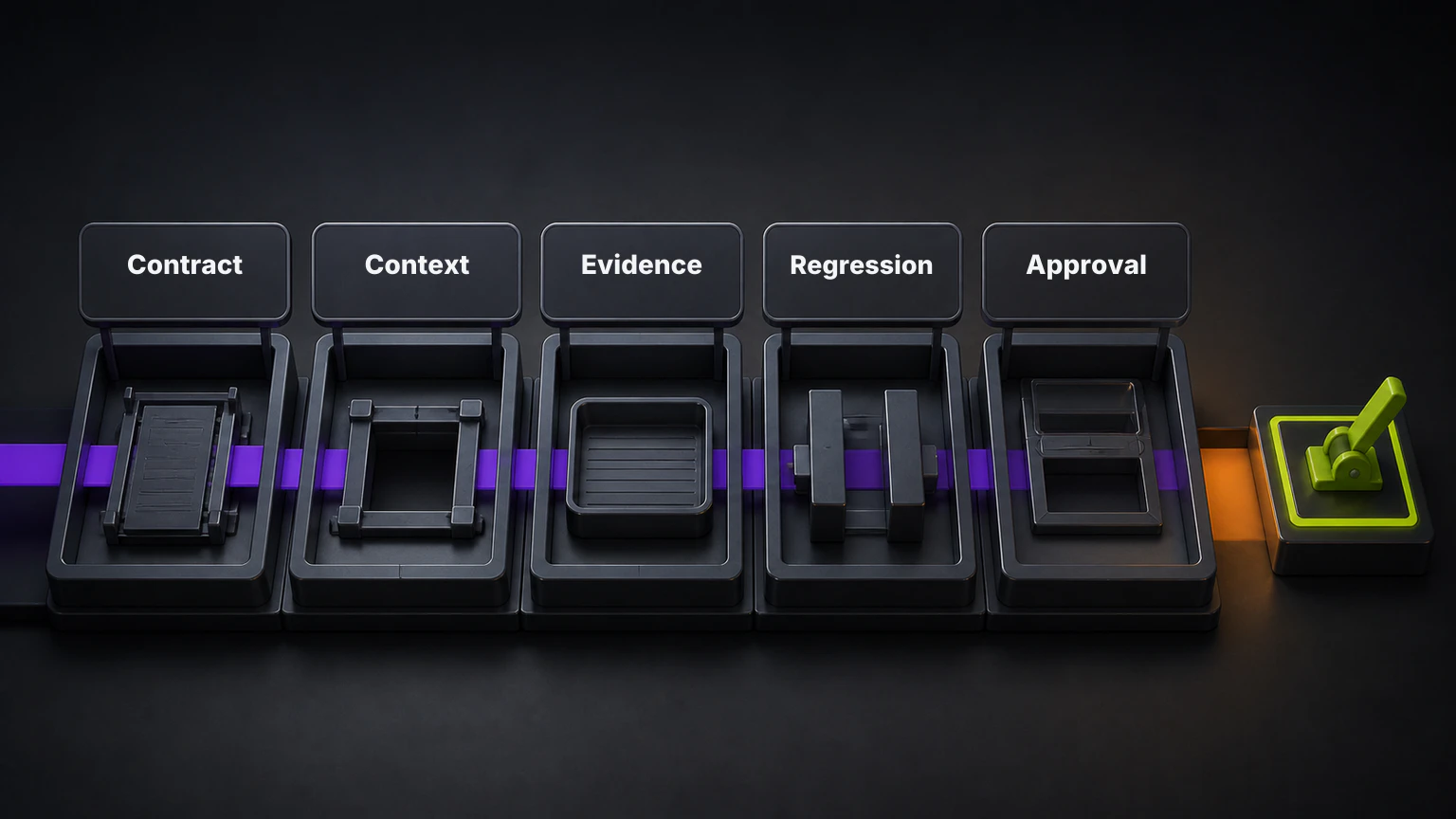
Vibe coding guardrails keep AI-generated changes inside an approved boundary and prevent completed work from becoming a production release without sufficient evidence. The five layers are a change contract, bounded execution, AI code review with release evidence, business regression review, and accountable approval.
This guide focuses on developer-facing AI coding tools such as Codex, Claude Code, Cursor, and GitHub Copilot. They work in repository-based workflows where generated code is available for technical review. Nontechnical Lovable or Base44 users may skip or delegate that layer, while the surrounding controls still apply.
Access limits ask what the AI system may do. Code review asks whether its changed code is correct. Regression review asks what established business behavior could break anywhere across the system. Production needs those distinct controls before a named owner approves release.
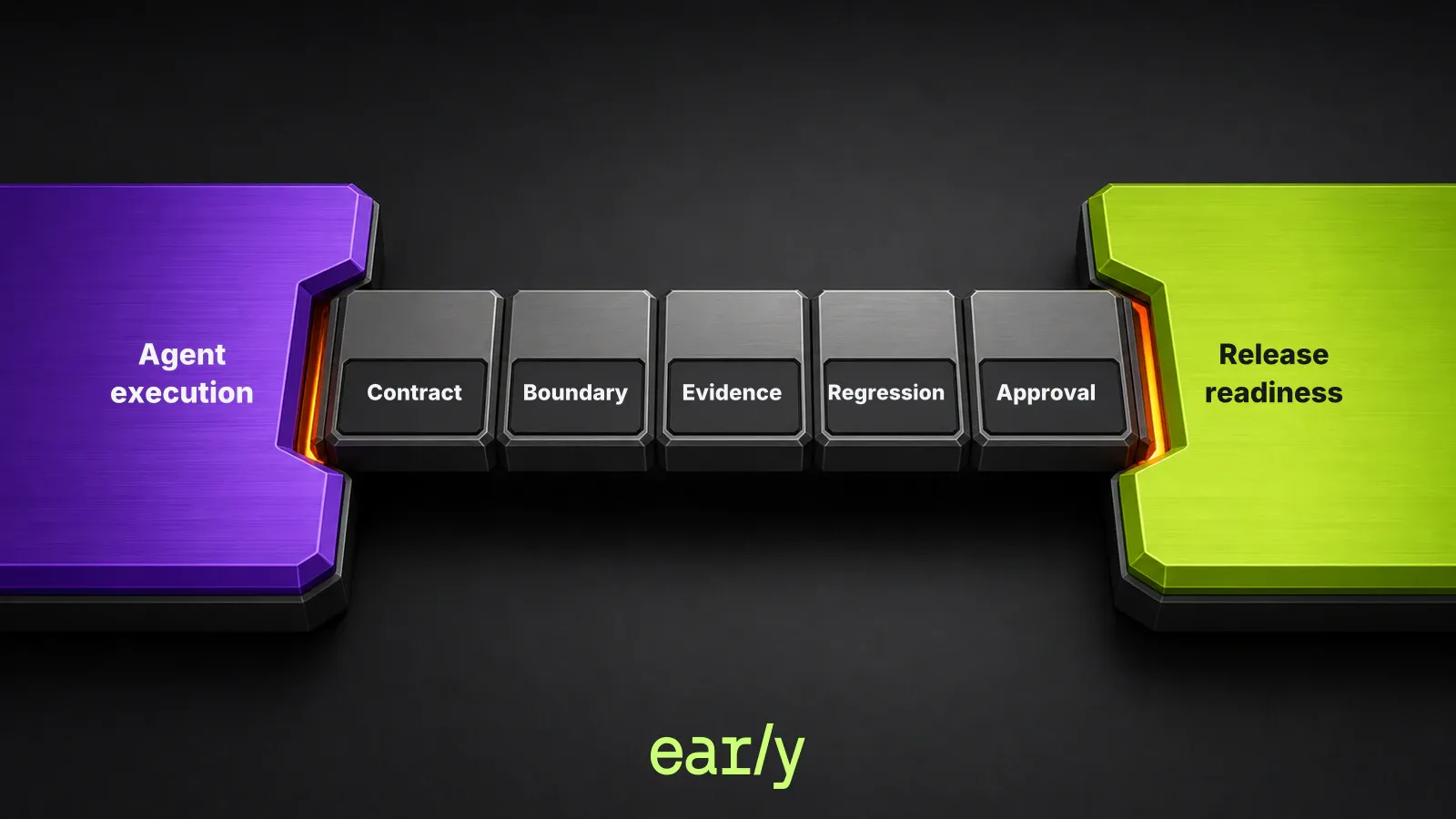
GitLab’s 2026 AI Accountability Report, conducted by The Harris Poll among 1,528 developers and technology buyers, found that 85% agreed AI had shifted the bottleneck from writing code to reviewing and validating it. Faster implementation raises the value of disciplined release controls.
The Five-Layer Vibe Coding Guardrail Stack
Use the five layers as one control system for repository-based coding agents. If no code-aware reviewer exists, code review becomes a delegated or skipped layer. The controls before and after it still apply.
| Layer | Control | Question it must answer |
|---|---|---|
| 1 | Change contract | What may change, and what must remain stable? |
| 2 | Execution boundary | What may the agent access and do? |
| 3 | AI code review and release evidence | If code can be reviewed, is it correct? In every workflow, what proves readiness for this exact release candidate? |
| 4 | Regression review | What established business behavior is at risk? |
| 5 | Accountable approval | Who accepts the remaining uncertainty? |
Consider one running example. A team asks an agent to add expiration to account invitations. The agent edits the backend invitation model and endpoint. The feature works in its local path, but invitation state also affects an existing frontend acceptance flow, membership activation, audit events, and notification retries.
The diff shows the backend change. The production decision has to account for the whole flow.
Layer 1: Write a Change Contract
A prompt describes a desired outcome. A change contract defines the boundary a reviewer will enforce.
For the invitation change, “add invitation expiration” leaves important decisions unresolved. Who may configure the expiration? What happens to an already accepted invitation? Does an expired invitation remain visible? Which audit event records the transition? What happens when the frontend sends an invitation token created before the change?
Write those decisions down before consequential work begins:
- Outcome: Invitations expire 72 hours after creation.
- In scope: Backend invitation state and acceptance validation.
- Must remain stable: Existing accepted memberships, permission checks, and audit history.
- Failure behavior: Expired tokens return a defined response without creating membership.
- Required evidence: Targeted checks, affected-flow review, migration assessment, and rollback plan.
The contract can be short. Its purpose is to expose decisions that should not be left to a likely completion generated from repository context. It also gives the reviewer a reference stronger than the final diff.
Layer 2: Enforce a Hard Execution Boundary
A coding agent is a process with tools, external inputs, and credentials. Good instructions help it choose. Hard boundaries determine what it can actually do.
Apply sandboxing, managed configuration, constrained network access, approvals, and agent-aware logs by default:
- Limit writes to the approved repository or working area.
- Deny network access unless the task requires named destinations.
- Keep production credentials, signing keys, and deployment authority outside the agent environment.
- Use short-lived, narrowly scoped credentials for necessary authenticated access.
- Treat repository text, issues, web pages, logs, and tool output as untrusted input.
- Record tool calls, command outcomes, network decisions, and approvals.
For the invitation task, the agent may edit the backend repository and run local checks. It does not need a production database credential, permission to send real invitations, or access to the deployment system.
Repeated approval prompts are not a substitute for boundaries. When every routine command asks for approval, reviewers learn to approve the interruption instead of evaluating the consequence. Reserve explicit approval for actions that cross a defined boundary.
Layer 3: Review Code and Preserve Evidence
AI code review is important when a developer or technical reviewer can evaluate the generated implementation. In repository-based workflows using tools such as Codex or Claude Code, it can compare the implementation with the task, inspect the diff and nearby context, and flag defects, security issues, or maintainability problems.
For nontechnical managed-platform users, code access does not create review capability. Skip or delegate code review when nobody can evaluate it.
Release evidence remains mandatory in both paths. The code review, platform validation, preview, and other checks must remain tied to the exact release candidate. “All checks passed” is not enough information for a release owner.
Revision-bound evidence is not another kind of code review. It is the audit record that identifies exactly which revision was reviewed, which checks ran, what passed, and what remains unverified.
Evidence must identify the version or revision, environment, checks, outcomes, and limits. Otherwise, a successful result from an earlier version or a different setup can be mistaken for evidence about the release candidate now under review.
A compact evidence record can look like this:
- Revision:
8f31c2a - Environment: CI, Node 22, test database fixture v14.
- Executed: Unit checks, API contract checks, and migration dry run.
- Result: All executed checks passed.
- Not executed: End-to-end notification delivery.
- Known limit: Legacy invitation tokens were sampled, not exhaustively replayed.
AI test automation can expand the checks attached to a release candidate. Teams use AI to automate testing because it reduces repetitive work, but those tests still confirm only the behavior represented by their assertions. An agent can misunderstand a requirement in both the implementation and a new test, while existing checks may not cover a dependent component. Evidence should make those limits visible rather than turning a green status into a broader claim.
Layer 4: Code Review vs. Regression Review
Code review and regression review are not competing methods. They answer different questions and require different context.
| Review | Primary question | Required context |
|---|---|---|
| Code review, including AI code review | Is the changed code correct for the stated requirement, feature, or bug fix? | The requirement, diff, changed files, nearby implementation, and relevant checks |
| Regression review | Could this release candidate break established behavior anywhere in the system? | The approved baseline, affected behaviors, and configured relationships across components and projects |
A code review evaluates the content of the change. A regression review evaluates the consequence of the change.
Even with broad repository access, code review is still centered on the proposed change. The regression question begins with everything that already works and asks what the change may have damaged.
Regression review does not require the release owner to understand source code. Its findings should identify the user journey, permission rule, integration, data transition, or operational flow at risk. That is especially important when the builder cannot perform code review.
In the invitation example, the backend edit can look correct while the frontend acceptance flow sends a token shape the new validation rejects. The agent did not edit the frontend, so that flow may never appear in the pull request. The failure sits in a relationship between components.
Review the release candidate against the approved baseline:
- Identify behaviors that depend on the changed code.
- Separate the broad set of affected behaviors from behaviors that actually changed.
- Inspect configured relationships across components and projects, including systems outside the edited repository.
- Trace each finding back to the source change.
- Record what the analysis could not establish.
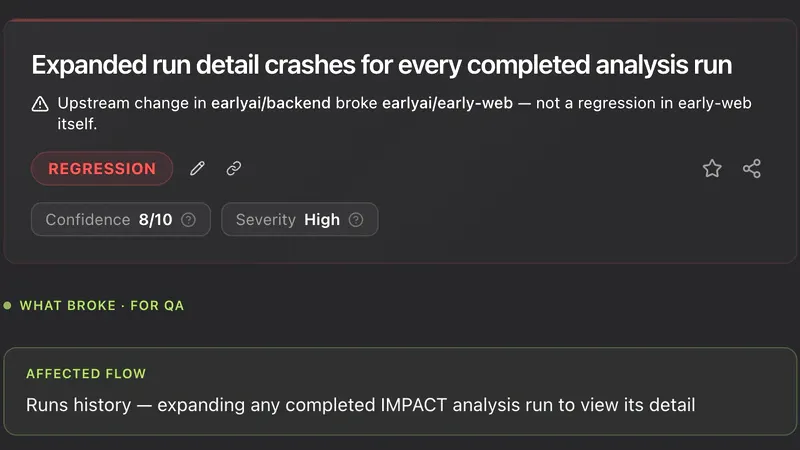
Early Release Guard finds and fixes bugs across configured projects and dependencies, including new bugs, existing defects, and regressions. Its regression analysis compares release-candidate code with an approved baseline, identifies affected and changed behaviors across configured relationships, and traces downstream findings to the source change. Regression Intelligence explains this capability within the broader product.
After authorized initiation, Early implements the fix for an eligible finding and opens a Fix PR with tests for the affected behavior. Engineers review the code and tests, amend them where needed, and control the merge. This applies the earlier execution and review boundaries to repair work as well as the original change.
Early’s message is Find. Fix. Know. Its value proposition is Automate repair. Scale engineering. Release with confidence. Keep the finding, fix revision, checks, actual results, and remaining uncertainty connected as work moves toward the accountable release decision.
Early carries the work from finding a bug to implementing a fix with tests. Engineers review the changes and control the merge, connecting the repair to the verification practices in this framework.
Layer 5: Keep Release Approval Accountable
The agent can prepare the change, assemble evidence, identify uncertainty, and recommend a next step. It should not convert successful execution into its own release authority.
Require explicit approval for high-impact actions and bind it to the actor, tool, target, parameters, time, and expiry. Apply the same discipline to release approval.
The approver should see:
- The intended change and behavior that must remain stable.
- The exact revision and environment evaluated.
- The checks that ran and the checks that did not.
- The affected behaviors and configured component or project relationships at risk.
- The unresolved assumptions and blind spots.
- The observation and rollback plan.
An approval detached from that evidence is only a click. Accountable approval means a named owner understands the consequence and accepts the remaining uncertainty.
For the hypothetical invitation change, an approval record should distinguish readiness from unresolved work:
| Record | Example |
|---|---|
| Candidate | Revision 8f31c2a, configuration and artifact linked to the evidence record. |
| Decision owner | Named release owner, with security and service-owner review attached. |
| Evidence | Expiry-boundary and authorization checks, client rejection handling, and migration dry run linked to this revision. |
| Open gap | Notification retries have not been exercised. The service owner must supply that result before approval. |
| Decision | Hold pending the missing check. Record the approver, time, and any accepted residual risk when that decision changes. |
| Recovery | Operations owner confirms the rollback procedure, including data compatibility, and watches defined invitation-failure signals during rollout. |
This is an illustrative team-owned record, not a Release Guard feature or a real release approval. A later candidate or material configuration change requires reassessment of the evidence and decision.
Scale Guardrails With Consequence
Do not use changed line count as the risk model. A one-line authorization edit can carry more consequence than a large internal refactor.
Use routine automated checks and ordinary review for bounded, reversible changes. Escalate when a change can alter access, persisted data, shared contracts, deployment authority, or recovery. Unclear impact is a reason to investigate, not a reason to assign the lowest tier.
The following is a suggested routing matrix, not a universal policy or a claim that any row guarantees safety:
| Change trigger | Evidence before release | Review and decision owner |
|---|---|---|
| Isolated, reversible presentation change with no access or data effect | Build and relevant UI checks, visible-result review, and a known revert path | Ordinary reviewer and the team’s release owner |
| Authorization, identity, secrets, or tenant-boundary change | Denied-access and cross-tenant checks, security findings, and explicit permission expectations | Security-qualified reviewer and accountable release owner |
| Schema, migration, or destructive data operation | Migration rehearsal, compatibility checks, and tested recovery or forward-repair plan | Data or service owner plus operations and release owner |
| Shared API, dependency, or event-contract change | Consumer compatibility evidence, affected-behavior checks, and unresolved-consumer list | Provider and affected consumer owners, with release-owner sign-off |
| CI/CD, deployment credentials, or infrastructure change | Reviewed privilege boundary, artifact provenance, rollout checks, and recovery procedure | Platform or security specialist and release owner |
An agent may help prepare any row’s evidence within its approved execution boundary. This matrix grants no additional credentials, production access, or release authority. If one person fills several roles, record that explicitly and obtain specialist review where their expertise is insufficient.
OWASP’s AI Agent Security guidance supports least-privilege access and human approval for high-impact actions. The release-routing matrix applies those principles to this guide’s workflow. It is not an OWASP certification checklist.
Classify consequence before execution. The classification should determine the environment, permissions, evidence, and approver. Increasing autonomy without improving release evidence only transfers uncertainty to the release owner.
Vibe Coding Guardrails Checklist
Before agent-generated code reaches production, verify that:
- Define the change: Outcome, scope, and stable behavior.
- Limit access: Files, tools, network, and credentials.
- Review and prove: Review code when qualified, then bind checks and gaps to the exact candidate.
- Review regressions: Trace affected behaviors to the source change.
- Own the release: Named approver, observation plan, and rollback.
Vibe coding guardrails should not end when the agent stops running. The final guardrail is a release process that can explain what the change puts at risk and who decided that the evidence was sufficient.
Frequently Asked Questions
What are vibe coding guardrails?
Vibe coding guardrails are technical and operating controls that define what a coding agent may change, how it may work, what evidence it must produce, how regression risk is reviewed, and who may approve a release.
What is the difference between code review and regression review?
Code review evaluates whether the changed code correctly implements the requirement, feature, or bug fix. Regression review evaluates whether that release candidate could break established behavior anywhere across the system. Code review centers on the change. Regression review requires system-wide context.
Are sandboxing and passing tests enough for vibe coding?
No. Sandboxing limits what an agent can access, and tests check behavior that somebody encoded. Neither one shows every established business flow a release candidate could affect or assigns responsibility for the remaining risk.
Should a coding agent approve or merge its own work?
A coding agent can prepare a change and assemble evidence, but release authority should remain with a person or separately governed process accountable for the consequence.
Do Nontechnical Vibe Coding Users Need to Review Generated Code?
No. AI code review is important when a developer or technical reviewer can evaluate generated code. Nontechnical users of managed app builders may skip or delegate that step. They still need release evidence, business-level regression review, and accountable approval before publishing.